A sensitive restoration by Gwathmey Siegel & Associates transforms Paul Rudolph’s Brutalist Yale masterpiece into an icon of sustainable design.
-
The Great Hall
The Great Hall
/Portals/3/images/magazine/0610/I_0610_Yale4.jpg
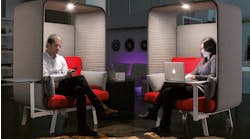
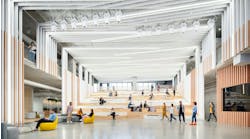
In the Great Hall, Viracon skylights spotlight Saarinen Womb chairs by Knoll.
View larger
-
Les Femmes au Perroquet - Women with Parrot
/Portals/3/images/magazine/0610/I_0610_Yale1.jpg
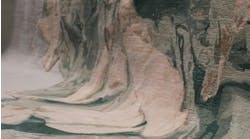
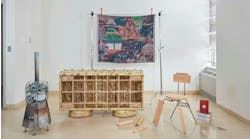
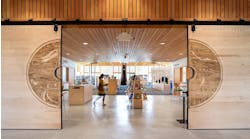
The single panel painted relief—“Les Femmes au Perroquet” (“Women with Parrot”) by Fernand Léger—which dominates the entry lobby of the new Jeffrey H. Loria Center, was gifted by Loria.
View larger
-
Rudolph Hall and the Loria Center
/Portals/3/images/magazine/0610/I_0610_Yale2.jpg
Rudolph Hall and the Loria Center, seen here from York Street (east), are bridged at ground level by the Haas Library.
View larger
-
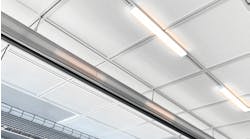
The skylights are also visible from floors above the third-floor roof
/Portals/3/images/magazine/0610/I_0610_Yale3.jpg
The skylights are also visible from floors above the Hall’s third-floor roof.
View larger
-
The restored Paul Rudolph Reading Room
/Portals/3/images/magazine/0610/I_0610_Yale5.jpg
Rudolph’s notorious orange carpet, reproduced by the Mohawk Group, is now sustainable, as are the historic reproductions of his incandescent fixtures. The restored Paul Rudolph Reading Room features
ICF’s Bauhaus lounge chairs, Mg5 chairs by Matteograssi and Breuer Laccio tables by Knoll. PHOTO BY RICHARD BARNES
View larger
-
Rudolph Hall exhibition gallery
/Portals/3/images/magazine/0610/I_0610_Yale6.jpg
Rudolph Hall’s renovated exhibition gallery boasts a new Armstrong ceiling with an attached Barcol-Air water-based radiant cooling and heating system. PHOTO BY PETER AARON/ESTO
View larger
-
east façade of the new Loria Center
/Portals/3/images/magazine/0610/I_0610_Yale7a.jpg
Natural limestone and zinc cladding are among the details revealed on the east façade of the new Loria Center. PHOTO BY RICHARD BARNES
View larger
-
The view from the renovated exhibition gallery
/Portals/3/images/magazine/0610/I_0610_Yale7.jpg
The view from the renovated exhibition gallery reveals Haas Library and exterior views. PHOTO BY PETER AARON/ESTO
View larger
-
Minerva, goddess of wisdom, presides over the fourth-floor jury space
/Portals/3/images/magazine/0610/I_0610_Yale9.jpg
Minerva, goddess of wisdom, presides over the fourth-floor jury space; the Roman statue is starkly
contrasted by bash-hammered “corduroy” concrete walls. PHOTO BY PETER AARON/ESTO
View larger
-
The green roof on the fourth-floor terrace earned LEED credits
/Portals/3/images/magazine/0610/I_0610_Yale10.jpg
The green roof on the fourth-floor terrace earned LEED credits; note the view of limestone-clad Rudolph Hall’s north façade.
View larger
-
Loria Center faculty office
/Portals/3/images/magazine/0610/I_0610_Yale11.jpg
Knoll’s Morrison workstation, Herman Miller’s Aeron desk chair and Arne Jacobsen’s Series 7 chair by Fritz Hansen can be found in this Loria Center faculty office. PHOTO BY PETER AARON/ESTO
View larger
SOURCES | CONTACT
H.L. Mencken, the notoriously acerbic Baltimore Sun scribe who never attended college, once wrote, “Those who can—do. Those who can’t—teach.” His famous witticism falls flat on its face when one considers the remarkable “doers” associated with the Yale School of Architecture.
Paul Rudolph was chairman when he built his most famous and controversial work: Yale’s Art and Architecture Building. Some 40 years later, Dean Robert A.M. Stern, one of Rudolph’s former students, commissioned the corduroy concrete landmark’s renovation. And the late Charles Gwathmey (who worked on Rudolph’s original design as a student draftsman) led Gwathmey Siegel & Associates Architects (GSAA) in restoring the Brutalist-era icon to its original glory.
Three celebrated architects. Three storied Yale educators. And a continuum of studying, teaching and advancing architecture that is now personified in the LEED Gold-certified Yale Arts Center. The $126 million project included: the restoration and expansion of the 113,000-square-foot Art and Architecture building (renamed Paul Rudolph Hall); design and construction of a new companion facility (the 87,000-square-foot Jeffrey H. Loria Center for the History of Art); and expansion of the Robert B. Haas Arts Library, which now bridges both buildings on the ground floor.
“Educational institutions like Yale are leading the sustainable design movement: Many are committed to radically reducing
their carbon footprints—some to zero footprints by 2030. And most aspire to as high a LEED rating as they can achieve,” explains Robert Siegel, FAIA, principal and founding partner of Gwathmey Siegel. “What’s really fascinating is that green design is driving architecture right now and universities are at the forefront,” adds Elizabeth Skowronek, AIA, senior associate at GSAA.
To meet Yale’s mandate that all new buildings achieve a minimum LEED Silver rating, Gwathmey Siegel focused on six categories: building envelope, MEP (mechanical, electrical and plumbing systems), site development, type and use of materials, lighting, and construction phase and process. “Considering we were working with a mid-century concrete building, we thought earning Silver would be a bit of a tough assignment. But we exceeded what we were asked to do and earned Gold,” says Skowronek, noting that for LEED purposes, Rudolph’s landmark facility and GSAA’s new building were considered one structure.
Indeed, the buildings are interwoven inside and out. “The interior spaces intertwine—the circulation systems intertwine, [and] the primary elevator system for both buildings is in the new building,” explains Siegel. That intentional symbiosis helped GSAA overcome obstacles which would have precluded LEED certification of Rudolph Hall.
“Reusing an existing building envelope was a big plus [for LEED] and a huge minus at the same time, because the envelope of the Rudolph building had a very low R-value,” notes Skowronek. The idea was to restore the older building to the extent where contemporary environmental standards could be met, and to design the best possible R-values into the new building.
“There were a lot of remedial repairs,” recalls Siegel. “We had to rebuild the main stair, redo all of the roofs, and literally remake every single window. The original Rudolph building was designed in a certain way in terms of fenestration, but window systems added later weren’t sympathetic to the original design.” GSAA removed everything that was contradictory to Rudolph’s design and re-glazed the building with low-E glass Kawneer windows and large insulated Viracon glass units.
Repairing the building’s signature cast-in-place concrete shell involved a combination of research and craftsmanship. “We were able to find one of Rudolph’s original concrete forms, and the people who originally did the bush-hammered concrete,” says Skowronek. Further research revealed that the ballast on the roof was the stone used in the original concrete. These discoveries enabled GSAA to restore the surface of the building precisely as it was originally constructed.
“That was Elizabeth’s primary role—returning the Rudolph building back to exactly the way it was intended to be,” says Siegel. He points to the building’s new radiant heating and cooling system and custom lighting fixtures as particularly inventive solutions—both architecturally and from a LEED point of view.
“The building had very specific lighting that defined its character, architecturally, and also defined the spaces,” he explains. “Rudolph installed hundreds of these incandescent fixtures on different mounting systems throughout the most monumental spaces, and we had to almost invent a fixture that could simulate them but also be infinitely more energy efficient.” GSAA’s lighting designer, Robert Leiter of HDLC, recreated the historic Rudolph lamps, exactly, with metal halide lamps from Winona Lighting.
Skowronek specified a dropped ceiling system by Armstrong with an attached water-based radiant cooling and heating system by Barcol-Air that utilizes existing hot and cold water from the main campus plant. Because of Rudolph’s original ceilings of sprayed-on asbestos (subsequently removed), there was little space for duct work. “It would have been so intrusive in terms of ceiling heights, and visually very objectionable,” notes Siegel. “These were a real discovery—they are so thin and so beautifully made you actually think that they were always there in place.”
That’s also true for Rudolph’s iconic orange carpeting—which was destroyed in a 1969 fire, and recreated from a salvaged 1-inch swatch by the Mohawk Group in sustainable iteration. In addition to specifying a myriad
of mid-century pieces from Knoll, Herman Miller, ICF and more, GSAA also recreated several of Rudolph’s original furniture designs. Some pieces were duplicated exactly; others, like his library tables, were modernized with amenities like cable management and computer hookups.
Looking back, Skowronek says the pedagogical aspects of the project were as rewarding as its LEED Gold certification. “Educating students of architecture on how to reuse a building was a rather interesting and exciting thing to do—what better way to show them how to convert an old building into a 21st century building,” she concludes. Those who can “do” green architecture are indeed its best teachers.
Carol Tisch is a freelance writer, editor and marketing consultant based in Sarasota, FL. She was formerly editor-in-chief of Shelter Interiors magazine and Home Furnishings News (HFN), and has developed communications programs for commercial and residential design industry clients. She can be reached at tischcomm@aol.com.
SOURCES:
back to top
CONTACT:
back to top
|
CLIENT
YALE UNIVERSITY
200 York St.
New Haven, CT 06520
|
PROJECT TEAM
ARCHITECTURE + INTERIOR DESIGN
Gwathmey Siegel & Associates Architects, LLC
475 10th Ave.
New York, NY 10018
(212) 947-1240
Charles Gwathmey, FAIA,
partner-in-charge/design partner
Robert Siegel, FAIA, design partner
Thomas Levering, AIA, project manager
Steven Forman, AIA,
project senior associate
Elizabeth Skowronek, AIA,
project senior associate
|
STRUCTURAL ENGINEER
Severud Associates
MECHANICAL ENGINEER
Altieri Sebor Wieber
CIVIL ENGINEER
BVH Integrated Services
GENERAL CONTRACTOR
Turner Construction Co.
ACOUSTICS / AV / TELECOMMUNICATIONS
Harvey Marshall Berling Associates
PRESERVATION
Gwathmey Siegel & Associates Architects; Hoffman Architects
ENVIRONMENTAL CONSULTANT
Atelier Ten
LIGHTING
HDLC
PHOTOGRAPHY
Peter Aaron/Esto and Richard Barnes
|